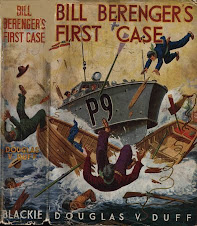
Bill Berenger's First Case
The pace of the first of Bill Berenger's four adventures is breath-taking. Eighteen chapters and 287 pages are crammed with excitement and incidents. There is scarcely ever a pause for reflection and yet the book succeeds in being a story of detection as well as a yarn of high adventure.
The hero, Bill Berenger, is the senior cadet on the Red Diamond Line's merchant -ship, the Chideock Mote, which, at the beginning of the story, is having its cargo unloaded in the port of Santa Monica, the capital city of the republic of San Isidore. Naturally San Isidore is one of the those South American states so beloved of storytellers that is on the brink of a revolution. However, make no mistake about it, Douglas Duff's creation of this fictional world is not a half-hearted one. Rapidly though the action moves, the reader is given the feeling of a real city and of real people, as though the author were drawing from his own memories of Spanish American life. In particular his descriptions of Bill's time amongst the poor people that haunt the Santa Monica harbour area are vividly convincing.
The affection that comes over for the honest fisherman Pedro Hernandez and his kind-hearted wife is matched by his disgust at the treatment he receives from Ignacio, the thief and police informer. The broken-down shacks, the junk yards, the rotting wharfs, the shabby mansions, the tumbling tenements, the Spanish forts, towers and the majestic cathedral, all form an important part of the backdrop of Bill's quest for the truth which becomes a fight for survival.
The plot starts slowly with the arrest of the second and third officers of the Chideock Mote for the murder of an Armenian store keeper and the impounding of the ship until all the evidence is collected. For some as yet undisclosed reason it becomes clear that the ship itself has a vital role to play in the coming insurrection. Bill Berenger makes up his mind that it is his duty to use his local knowledge, his ability to speak the Spanish dialect and the training he received from his father in police methods, in order to save the day. However, first he has to make a difficult moral choice. Jumping ship or desertion will mean placing himself outside all the normal laws and guarantees of British justice. It will also mean leaving his comrades in the lurch. If he fails, he faces at the worst death and, at the best, the sure knowledge that he can never return again to his safe and comfortable world.
An investigation of the murder scene carried out by torchlight gives Bill a series of clues which he investigates with both intelligence and thoroughness. The very manner of the Armenian's death is striking. He has been kicked in the windpipe by an expert, a man with skill in Savatte or foot-boxing. All the clues point towards a local underworld boss with the nickname Red Iago. Even when all Bill's evidence is placed in front of the Minister for the Marine, he refuses to let the two officers go. It is clear that there is corruption in high places. The official government and police force are riddled with informers and traitors. It is almost impossible to know whom to trust. Even Bill himself, still in disguise, is recruited to be an assassin, carrying a briefcase full of explosives to the home of the one honest man, Miguel de Valdez.
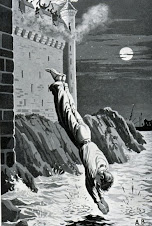
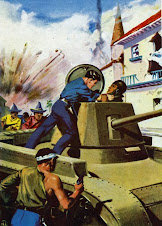
There are many exciting episodes in this story. Best of all perhaps, is the moment when Bill is attempting to escape from the Presidio prison amongst the chaos of a prison riot. He stands perched on the battlements of the ancient fortress ready to dive into the dark waters below, not knowing if there are rocks immediately underneath him. He has the comforting thought that if he lands safely it will be at the very point where sharks are fed regularly every day ! Later there is a high-speed chase in patrol boats in Santa Monica's narrow harbour.
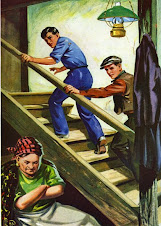
Strangest of all, perhaps, is the fact that the book reaches page 227 before Douglas Duff decides to introduce the heroine into the story. Her name is Janet Eve Wallace and she is a young American whose father owns important oil concessions in the hinterland of San Isidore. She is a girl of courage and determination, leaping across rooftops and down staircases with only a moment's hesitation. The book ends with the two young people looking forward to meeting up again.
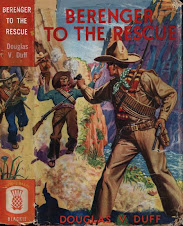
Berenger to the Rescue
Where the first story in the quartet was set in the big city of Santa Monica, this adventure is very much one of the wide open spaces. In fact the sheer scope of the action is one of its most attractive features. The detective element is contained in the first few chapters and, it has to be admitted, this is the weakest part of the whole book.
Bill Berenger is back in England once more, hoping for some shore leave so that he can see his newly acquired girlfriend, Janet Eve Wallace, visiting London with her millionaire parents. However, an invitation that can't be turned down takes the unfortunate cadet to Cornwall and the home of the chairman of the shipping line, Sir Alan Pascoe. Sir Alan's son, Geoffrey, has been kidnapped and Bill is asked to help track him down. The kidnappers are the revolutionary organisation, the Green Camisardos, who are once again trying to overthrow the democratically elected government of San Isidore. Sir Geoffrey's ships are to be used to import over 600 German mercenaries and, if he does not cooperate, the head of his son will be sent to him by registered post. Worse than all of this is the news that Red Iago, the villain of the first book, has escaped from the island prison of Isola Jehannum.
Once more Bill begins his investigations by meticulously noting all the details of Geoffrey's disappearance. His conclusions lead him to believe that the kidnappers must be staying at the nearby luxury Headlands Hotel. Immediately he decides to gain employment there as a "Boots". First of all, however, he makes a trip to London and this is where the plot creaks with improbability. As he travels up on the Cornish Riviera Express by chance he finds himself seated at the same dining table as three of the enemy kidnappers ! Of course, they don't realise who he is and chat away in Spanish, little realising that he is word-perfect in that language. In London there is little time for romance with Janet Eve, though there are signs of increasing affection between the hero and heroine. "Bill took her hand and started to tell her exactly what he thought of her, and no one has ever looked more annoyed than did Janet Eve Wallace when her father and mother came into the room…."
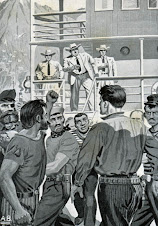
In fact Duff only regains control of the plot when Bill too is taken prisoner and he and Geoffrey Pascoe face the perils of an Atlantic Ocean voyage on board a luxury yacht with a "bucko" mate and a "bluenose" captain. A hurricane further complicates matters. The crew comes near mutiny and some are ruthlessly shot down by the mate as he assumes command after the death of the captain. As the coastline of South America draws near, Bill and Geoffrey make their own plans for escape and a journey in an open boat, shipwreck, pursuit by hostile Indians, rivers full of alligators are only some of the perils that have to be faced as they make their way to safety.
Geoffrey is only eleven and it is clear that Duff has used this lack of years as a device to draw in the younger readers. The young lad behaves courageously and also suffers tremendously.
It is also at the end of the story when you have time to reflect that you realise that Bill Berenger has adopted at least four different disguises (including the habit of a nun !) and killed up to a dozen men. He has crossed many different terrains – the midnight streets of Pimlico, the windswept moorlands of Cornwall, the sands and jungle of the coastal plain, the high sierras of the Irredentas, the cataracts of a mountain river in full spate, and that all these landscapes have been convincingly and interestingly described. Whatever the disadvantages of using a fictional country, Douglas Duff gives you a wonderful impression of a mighty continent whose scale is quite awe-inspiring. And I haven't even mentioned the underground Inca man-traps !
Bill Berenger Wins Command
On board the British cargo vessel, the Messack Mote, a murder has taken place. A harmless old man has been put to death. The fact that he was the Chief of Staff of the San Isidore Armed Forces means that the event is political dynamite. Already the Red Diamond Company has developed an unenviable reputation for danger and disaster in the great republic of San Isidore. Its ships disappear and accidents happen with inevitable frequency on their railroads and in their mines. Though promoted to second mate, Bill Berenger finds that before joining his new ship in Santa Monica, he must try to solve the crime that threatens to condemn the British company to further censure and eventual oblivion. Once again Douglas Duff starts his book with detection in a confined space and then opens it up into a rip-roaring adventure.
Apart from the Captain of the Messack Mote the other officers are sceptical of the efforts of "Young Sherlock", as they sneeringly call Bill. To their consternation his systematic method of listing the clues and the suspects once again pays dividends. No sooner have he and the captain made the necessary arrests than Bill decides that the only way for him to overcome the saboteurs who are ruining the Red Diamond line is to go under cover disguised as Blomberg, one of the murderers. And from that point onward it is a search for the mysterious "El Grande" who has his own plans for taking over the giant South American republic.
In very quick order Bill becomes a burglar and then a truck driver. He gradually uncovers the clues in the grand conspiracy but his only safety lies in everyone believing that he is dead. This includes Janet Eve, his girlfriend. Both Bill's friend, Valdez, and Janet Eve' s parents believe Bill is dead and can't face telling her. So one day, when a letter arrives out of the blue, the girl is both dismayed and then rejuvenated. Things have now progressed so far in their relationship that he calls her by a special pet name "Jayee".
As the convoy of trucks climbs higher up the roads in the Cordilleros Ultimos Bill realises that all his predictions about what was about to happen have gone astray and that he is getting further and further away from any help and from the girl that he loves. To get back down to civilisation once again involves some of the most exciting writing in the whole series – sufficient to say it involves an ice-yacht, a frozen water fall and an encounter with savage forest Indians. The finale of the story happens at sea in "The Port of Missing Ships" and, at the end of the adventure Bill is told he will have to make up his mind whether he wants to be a detective or a sailor. Jayee has already made up her mind that he will be neither and Bill is wise enough not to contradict her.
All the usual ingredients are present but, whilst the mountain adventures are up to the old standard, the last section on board ship is an anti-climax.
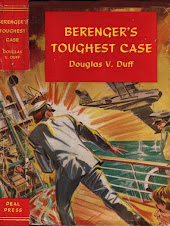
Berenger's Toughest Case
Having outwitted Red Iago in two adventures and disposed of El Grande in the third, Bill takes on the most dangerous villain of all in the fourth and final story. This man is called the Fire Seraph and he is completely insane.
Summoned to the head office of the Red Diamond Line Bill is told by the Chairman that it is his job to ensure that the Melplash Mote with its cargo of United Nations atomic weapons gets safely to the Republic of San Isidore. "And if she doesn't," Bill put in grimly, "I suppose I shall be blown sky-high." "If that happens, you won't need to worry about anything ever again," Sir Adrian replied, his smile becoming very friendly.And the usual roller-coaster of events is set in motion.
Kidnappings on the streets of London, time-bombs in the ship's hold, bombings by a flying boat, fire in an explosives store, and attacks by sharks. Bill comes through them all as usual. The Fire-Seraph's plans for a Latin American super-state come to nothing and Bill finds himself home at last on the estancia owned by his father with all his loved ones, including Jayee, around him. The adventure is not yet over, for the Fire Seraph has eluded capture and wishes to take a dreadful revenge on the man who thwarted all his plans. A horde of over six hundred wild men from the mountains surrounds the remote ranch and then begins to move in closer.
It seems that to save everything precious in his world Bill has to sacrifice himself to certain death. And there let us leave him, saying farewell to Jayee."I still think you're wrong, Bill," she said quietly, "but I understand what is driving you, and oh, my dear, if you are killed by those devils out there, I shan't care how soon it is before they break in and make an end of me."
An Overview of the Series
In the opinion of this reviewer the first two stories in the series are by far the best. The contrast between the city adventures of the first case and the great outdoors of the second demonstrates Duff's versatility. I can recommend these without reservation. The third story has its moments, including the splendid ice-yacht episode and the last shows signs of tiredness and, without doubt, is the weakest. It's time that Bill settled down with Jayee and raised a family in San Isidore, a country that should at last be free from the perpetual danger of armed revolution.
It should be noted that quite a few of the details of these Berenger stories had already been given an airing in "Peter Darington – Seaman Detective". This includes calling the heroine Janet ! On another lighter note Duff obviously enjoyed an in-joke for one of the apprentices in "Berenger Wins Command" was called Dick Valder. Valder is, of course, Douglas V. Duff's unusual second name. #
Tuesday, 7 April 2009


Monday, 6 April 2009
Peter Darington-Seaman Detective (Thames Publishing Co)
The hero of this book, Peter Darington, fulfils the two roles defined in the above title in a highly satisfactory way. More than that, Douglas Duff’s creation in this early collection of 8 short stories is clearly the forerunner to his later series heroes - Bill Berenger and Adam MacAdam. From the very start of his adventures Peter is given all the qualities that any young reader could still admire today. He is brave, intelligent, compassionate, understanding and just vulnerable enough to make his success not too predictable. The author’s cosmopolitan outlook is also refreshing and reflects his wide experience of the world and the people in it. It is not often that you open a book about a young British hero and read a line which says,“Peter knew Arabic and both understood and loved Arabs…”Other ethnic groups are also usually treated with a respect and an even-handedness that allows Duff to create “goodies” and “baddies” in all the nations that are visited without there being a suggestion of a racial slur. It is behaviour that matters - not the colour of a man’s skin.
A tramp steamer with a limited number of passengers on board is, of course, the ideal setting for a murder mystery. Two of the stories make use of the confinement that is achieved by a long voyage where no one can have committed the crime but the passengers or the crew. Falling under suspicion himself, Peter remembers the training given to him by his father, senior officer in the Palestine Police. He makes a numbered list of all the clues and weighs up the pros and cons about each suspect. There may be painstaking method but there is also satisfying mayhem as each case is normally resolved not just by deduction but also by fisticuffs. Peter knows how to disarm a desperate gunman and then knock him out with “a magnificent uppercut”.
Inevitably Peter Darington’s success as a detective brings him to the notice of his superiors, with mixed results. Becoming the “pet” of the Captain does not make him popular with the Chief Officer of the Roundstone Minster and it also leads to some “ragging” from his fellow apprentices. His youthfulness counts strongly in his favour, however, when he investigates the case of “The Kidnapped Heiress”, for who would suspect one of such tender years to possess such tenacity and courage.
Indeed, the heiress in question is one Janet Summerthly, the daughter of the millionaire owner of the Red Circle Shipping Line. Soon Peter is moving in exalted circles and begins to harbour thoughts he hadn’t expected to trouble him.
“He had never bothered very much about girls, but she was so different from all the rest.”
As he pursues the criminals in “Terror by Night” he begins to think about Janet more seriously. She has already proved her courage by seizing an unexploded bomb and rushing outside to throw it into a lake. As he drives along, “Not for the first time, Peter realised that she was also an extremely pretty girl.”
Here we can see quite clearly where Douglas Duff differs from Percy F. Westerman, that other prolific writer of sea stories whose career overlapped Douglas Duff’s for at least thirty years. Duff is not afraid to introduce the female element into his stories and, though the girls concerned play minor roles, they are always strong self-reliant types, whose independent character wins the respect of the hero and forces him to greater efforts to win theirs in return. Janet Summerthly is no swooning maiden. She totes a gun and is prepared to use it. In Westerman stories the lads concerned are lucky if they have mothers, never mind “lady friends”.
Mere courage and resourcefulness will not be enough for Peter to win Janet. Interestingly he has to overcome his own prejudices and the assumptions of the world he lives in. He forces himself to stop thinking of her – “he was an apprentice in her father’s employ and she was the owner’s only daughter. Things such as he had begun to imagine didn’t happen. At least, decent fellows didn’t let them happen, and that was all there was to it.”
In the next short story in the book, “Dangerous Mission”, Peter leaves England and Janet behind and the Roundstone Minster encounters a troubling political situation in the South American Republic of San Isidore. This again, like the Palestine and Arab connections already mentioned, is a constantly recurring theme in Douglas Duff’s stories. The Republic of Yraguay in the Adam MacAdam stories, for instance, brings out the close connection between the United Kingdom and the many Latin American states where Britons have traded, settled and intermarried. The resolution of the mystery in this story concerns a smuggling technique referred to in one of another collection of Duff short stories entitled “Heroes of the Sea”. The breadth of the author’s sea-going experience is never in doubt.
For his success in this story Peter and one of his shipmates are awarded the M.B.E., but what we really want to know is whether the author will reward his hero with the lovely and lively Janet. In “Midnight Mystery”, depending on your point of view, the signs are not good. Peter is now so sensitive on the subject of the millionaire’s daughter that he can be provoked into instant anger by his fellow apprentices’ callous disregard for his feelings. Their constant jokes about his future prospects expose a raw nerve that threatens to make him lose his normal level-headed approach to each problem that crops up. The mystery in this story is one of the author’s weakest and the Duff wraps it all up rather tamely without a dramatic climax.
However, the fiery Janet and the touchy Peter cause so many sparks of interest by their disagreement that the reader is more interested in the progress in their “impossible” relationship. And how does it end ? Of course, you have to read the book yourself to find out.
One of the most attractive features of this oversized book from “The Headway Library” is the beautiful display made by the seven coloured plates by Nat Long. In particular the picture of Janet racing through the French windows makes you understand just why Peter finds her both so brave and so desirable
Douglas Duff wrote many better books later in his career but this mixture of detective story and action thriller gives indications of what would be possible when he moved from the miniature of the short story and painted with these colours on a broader canvas.
A tramp steamer with a limited number of passengers on board is, of course, the ideal setting for a murder mystery. Two of the stories make use of the confinement that is achieved by a long voyage where no one can have committed the crime but the passengers or the crew. Falling under suspicion himself, Peter remembers the training given to him by his father, senior officer in the Palestine Police. He makes a numbered list of all the clues and weighs up the pros and cons about each suspect. There may be painstaking method but there is also satisfying mayhem as each case is normally resolved not just by deduction but also by fisticuffs. Peter knows how to disarm a desperate gunman and then knock him out with “a magnificent uppercut”.
Inevitably Peter Darington’s success as a detective brings him to the notice of his superiors, with mixed results. Becoming the “pet” of the Captain does not make him popular with the Chief Officer of the Roundstone Minster and it also leads to some “ragging” from his fellow apprentices. His youthfulness counts strongly in his favour, however, when he investigates the case of “The Kidnapped Heiress”, for who would suspect one of such tender years to possess such tenacity and courage.
Indeed, the heiress in question is one Janet Summerthly, the daughter of the millionaire owner of the Red Circle Shipping Line. Soon Peter is moving in exalted circles and begins to harbour thoughts he hadn’t expected to trouble him.
“He had never bothered very much about girls, but she was so different from all the rest.”
As he pursues the criminals in “Terror by Night” he begins to think about Janet more seriously. She has already proved her courage by seizing an unexploded bomb and rushing outside to throw it into a lake. As he drives along, “Not for the first time, Peter realised that she was also an extremely pretty girl.”
Here we can see quite clearly where Douglas Duff differs from Percy F. Westerman, that other prolific writer of sea stories whose career overlapped Douglas Duff’s for at least thirty years. Duff is not afraid to introduce the female element into his stories and, though the girls concerned play minor roles, they are always strong self-reliant types, whose independent character wins the respect of the hero and forces him to greater efforts to win theirs in return. Janet Summerthly is no swooning maiden. She totes a gun and is prepared to use it. In Westerman stories the lads concerned are lucky if they have mothers, never mind “lady friends”.
Mere courage and resourcefulness will not be enough for Peter to win Janet. Interestingly he has to overcome his own prejudices and the assumptions of the world he lives in. He forces himself to stop thinking of her – “he was an apprentice in her father’s employ and she was the owner’s only daughter. Things such as he had begun to imagine didn’t happen. At least, decent fellows didn’t let them happen, and that was all there was to it.”
In the next short story in the book, “Dangerous Mission”, Peter leaves England and Janet behind and the Roundstone Minster encounters a troubling political situation in the South American Republic of San Isidore. This again, like the Palestine and Arab connections already mentioned, is a constantly recurring theme in Douglas Duff’s stories. The Republic of Yraguay in the Adam MacAdam stories, for instance, brings out the close connection between the United Kingdom and the many Latin American states where Britons have traded, settled and intermarried. The resolution of the mystery in this story concerns a smuggling technique referred to in one of another collection of Duff short stories entitled “Heroes of the Sea”. The breadth of the author’s sea-going experience is never in doubt.
For his success in this story Peter and one of his shipmates are awarded the M.B.E., but what we really want to know is whether the author will reward his hero with the lovely and lively Janet. In “Midnight Mystery”, depending on your point of view, the signs are not good. Peter is now so sensitive on the subject of the millionaire’s daughter that he can be provoked into instant anger by his fellow apprentices’ callous disregard for his feelings. Their constant jokes about his future prospects expose a raw nerve that threatens to make him lose his normal level-headed approach to each problem that crops up. The mystery in this story is one of the author’s weakest and the Duff wraps it all up rather tamely without a dramatic climax.
However, the fiery Janet and the touchy Peter cause so many sparks of interest by their disagreement that the reader is more interested in the progress in their “impossible” relationship. And how does it end ? Of course, you have to read the book yourself to find out.
One of the most attractive features of this oversized book from “The Headway Library” is the beautiful display made by the seven coloured plates by Nat Long. In particular the picture of Janet racing through the French windows makes you understand just why Peter finds her both so brave and so desirable
Douglas Duff wrote many better books later in his career but this mixture of detective story and action thriller gives indications of what would be possible when he moved from the miniature of the short story and painted with these colours on a broader canvas.
Sunday, 5 April 2009
Douglas Valder Duff - Man With Many Names
The Many Lives of Douglas V. Duff by Jim Mackenzie
Two of the recent correspondents to Collecting Books and Magazines have raised additional information about the life and works of the author Douglas V. Duff.
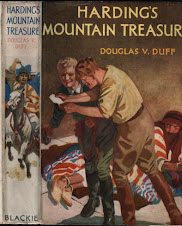
The first of these, Jim Herlihy of Ireland, contacted us about a missing book from the list that was given on these pages. This was "Harding and the Mountain Treasure", a copy of whose dust-jacket can be found here. Thus we can solve one Harding mystery but must immediately raise another that our readers may be able to put to rest. The British Library records that there are 5 books in the Jack Harding series. However, I have only been able to record four titles 1. Harding of the Palestine Police. 2. Harding and the Mountain Treasure 3. Harding and the Screaming Mantle 4. Jack Harding's Quest. The fifth book title , whose action must lie somewhere between book 1 and book 4, has so far eluded our searches. Perhaps you know it and we can add it to the records on these pages.
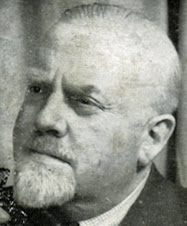
Jim Herlihy also uncovered some very interesting facts about Douglas Duff's early life. The ship that Duff was on during World War 1 and from which he was the only survivor when it sank was called the S.S.Thracia. Jim pointed out that you can now use a search engine to see details of an underwater dive to the wreck off Britanny. Using the words "S.S. Thracia " will also lead you to a remarkable document which is a scan of the original handwritten record of the French sailors who rescued "Douglas valderduff" from the sea. Jim also send on a copy of a photograph of Douglas Duff when he was in the uniform of the Palestine Police,which we reproduce here.
Douglas Stanhope
On Special Service for the Foreign Legion; 1947 Blackie
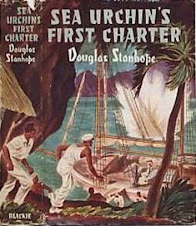
Sea Urchin's First Charter; 1947 Blackie
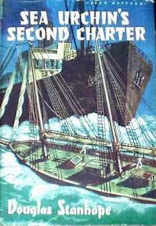
Sea Urchin's Second Charter; 1948 Blackie
Sea Urchin's Third Charter; 1949 Blackie
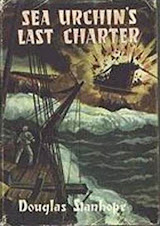
Sea Urchin's Last Charter; 1951 Blackie
Leslie Savage
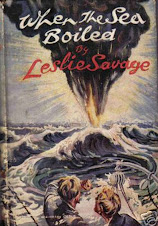
When the Sea Boiled; 1948 Hollis and Carter
Cornish Contraband; 1950 Herbert Jenkins
Peter Wickloe
The Yellow Ship; 1947 Blackie
To the coasts of Barbary; 1947 Blackie
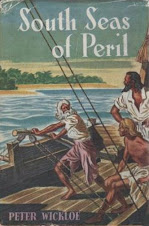
South Seas of Peril; 1948 Blackie
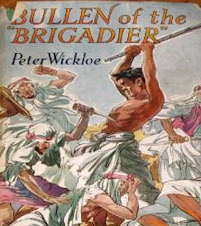
Bullen of the "Brigadier"; 1949
With the Knights of Malta; 1950 Blackie
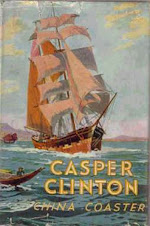
Casper Clinton. China Coaster; 1951 Blackie
Mainsail
Fifty Famous Sea Stories 1961
Here are some of the dust-jackets. Some of the books were already in my collection. I had suspected their authorship but had never done anything to prove it. The British Library saved me the job.
You can see that the years between 1947 and 1951 were extremely busy ones indeed. A brief count will reveal he wrote 13 books under these known pseudonyms whilst still turning out 19 under his own name, including the entire "Bill Berenger" series and volumes of autobiography.)
Just how prolific he was during these years is illustrated by my copy of "The Treasure of Antarctic" where the dust-jacket proclaims a list of "Blackie's New Books for Boys". These include "Trapped in the Jungle", "The Phantom Submarine" and "Unfettered Might" by Percy F. Westerman. Duff's titles under his own name were "Atomic Valley", "Islands of Jeopardy" and "The Lost Admiral". As Peter Wickloe he contributed "The Yellow Ship" and "To the Coasts of Barbary and, as Douglas Stanhope, "Sea Urchin's First Charter" and "On Special Service for the Foreign Legion". The other authors mentioned were C.B.Rutley and Douglas Castle. Both Westerman and Rutley were well known to me. For a while I toyed with the idea that Douglas Castle might again be Duff in yet another guise. The British Library, however, confirms that this was the pen-name of John Ridley Brown. However, let us take a look at the author we know so well as he operates in disguise.
"Casper Clinton China Coaster" by PeterWickloe
This story by Douglas Duff shows the author in typical form. The scene of the action is the South China Seas. The hero is Casper Clinton, a man of unknown origin and mixed race. He has been brought up by Theophilus Clinton on the remote Balabac Island near north Borneo to work hard and respect men of all colours and races. At the end of the Second World War, when he acted as a guide and interpreter to the Australians and the Americans, he is given the opportunity to train as a cadet-officer in the BritishMercantile Marine.
When his first ship, the Trecarrel, runs into a mysterious barquentine Casper is sent on board to help as part of the crew who are going to sail the apparently abandoned vessel into Hong Kong. However, on board lurks danger in the shape of a group of deserters from the French Foreign Legion. After the Trecarrel draws away the unlucky officer is killed and Clinton and his Chinese comrades are left at the mercy of ruthless German renegades. Casper, as the only person capable of navigating, pilots his way towards the coast of south China. Out of the darkness one night the barquentine is attacked by the crews of pirate junks who capture them and take them to Swachow.
This little enclave is ruled over by the autocratic Lady Soong Ayesha who enforces her authority by means of a constantly busy execution squad. Casper Clinton and his friend Ah Fong are pressed into the Lady's service and the young man finds himself running a navigation school for the strange but brutal Chinese woman. It takes all of Casper's ingenuity to plot his escape and keep one step ahead of the people who want to betray him and win favour with the Lady Ayesha.
The escape from Swachow is made in the nick of time and during a remarkable typhoon. The barquentine makes a run for the south and the book becomes a story of remarkable endurance by Casper and Ah Fong. Their troubles are not over when they make a landfall at a remote island, where they find themselves prepared as sacrifices to a strange island cult ! Only some remarkable stage trickery by Ah Fong allows Casper to turn the tables and to allow them to return to safety and civilization once more.
Sea Urchin's Second Charter by Douglas Stanhope
The Sea Urchins were a group of five men who had all been demobilized from the Royal Navy, but who, not liking the prospect of settling down ashore, had bought the ship in which they were serving, the schooner "Sea Urchin". She was a very special vessel indeed, for she had been built for the Irregular Warfare Flotilla, and, while looking like an innocent sailing craft, had concealed aboard her a mass of special equipment and gear.
The premise of each charter is that the group take on special assignments that no one else either wants or can manage. During the war Andrew Barton was the commanding officer with Bill Sims as his second. Sam Somers had been in charge of the guns and Tom Fuller was the radio officer. Old Amos, a sixty five year old Negro, was the cook. However, in peace time all five are equal partners in their enterprises.
On this charter they accept the money of a chemical company who want them to find a missing Cornish man called Penwithers, who is believed to hold the secret of a remarkable medicine. Unfortunately during his war service Penwithers disappears on the island of Madagascar. The political situation on the island is highly volatile, with the colonial power, the French, trying to hold down a rebellion by some of the Malagasy people who live in the remote highland mountains. The plan is for Bill and Amos to find their way to the rebel stronghold to follow up the rumours of a "Blind White Saint". To complete their mission they will have to pass as Muslims as all Europeans are automatically executed by the rebels. Bill and Amos pretend to be arms traders and, after a brief brush with the French soldiers, are picked up by the people who want to purchase weapons for the great rebellion.
There is a long trek to a remote mountain stronghold where they find the situation complicated by the rivalry between so-called "Saint" and an old hag who is a traditional mother-of-the-people witch-doctor who holds enormous power. A radio message tells Bill and Amos that the Sea Urchin has been attacked by other scientists who are on the trail of the marvellous and invaluable medicine. At this point in the story the two heroes are suddenly cast into a prison.
Thus they need to escape from the prison fortress, cross a crocodile-infested rivers and then dodge the rival organisation who have apparently sunk their schooner and killed their friends.
The fact that there are several more "charters" to come in the saga should soon relieve your anxiety about their survival.
After the flood of stories as Duff moved into the 1950s, the pseudonyms seem to drop out of usage and perhaps any dispute with Blackie had been settled by this point. The dust-jacket of "The Ruses of Ruby-Anne" makes this interesting contribution to the Duff career story :-
"When the author of this book formed one of the panel in Television's 'What's My Line' he startled the chairman by speaking to one of the challengers in Arabic."
Duff's appearances on 'What's My Line' are not recorded on the information you can find on line. However,'What's My Line'; first appeared in Britain in 1951 just after the purple patch of his writing career that we have recorded here. Perhaps his television appearances are another reason why Duff gave up the pen-names.
His use of "Mainsail" as his name as editor for the Burke series called "Fifty Famous Sea Stories" allowed him to bring together a collection of classic sea stories by Melville, Kingston, Henty, Ballantyne and many more without compromising his work for Blackie and Nelson. And, so, I thought the story of his many identities had now come to an end. The British Library revealed no more known pseudonyms.
Two years ago in a small second-hand bookshop in the town of Whitby I learned that I was wrong.
Amongst the few books that fell into my area of interest was "The Long Haul" by Alan Paxton. The dedication at the beginning of this book in the common or garden "Abbey Rewards" series was to "Stella B. Buckwalter who, young in heart, has always liked the young books I have written."
I was sure I had seen this dedication before but I couldn't be certain. I bought the book and took it home. I can now confirm that in "Sea Urchin's Second Charter" the dedication runs thus, "To Stella Buckwalter in the hope that this yarn may interest her ever-youthful spirit."
In "Harding's Mountain Treasure" it reads "To one of my youngest friends, Stella V. Buckwalter, I dedicate this tale for boys of all ages, in the hope that she will enjoy it."
Having read the book I can now say that Alan Paxton is definitely another name for Douglas Valder Duff. So many of the old favourite themes and incidents crop up again. The story begins in H.M.S Harlech, a Cadet Training School closely based on H.M.S. Conway. Tim Nuttal and his brother Alistair are cadets who have a father who served with the Royal Navy in spite of the fact that they are citizens of the South American Republic of San Ignacio. Indeed the entire family are sailing home to San Ignacio in their ketch Mantlet for the summer holidays. When you learn that the other member of the family is sister Janet (It is that name Janet again !) you can feel Duff weaving the old story one more time.
Encounters with an underwater volcano (see "The San Matteo" and various others) and with sea serpents "(see "Sea Serpent Island") take us down to familiar territory. The magnificent description of the small yacht's battle with a hurricane echoes the ones to be found in "Ocean Haul" or "Casper Clinton". The clinching moment for me came when the two boys take their dismasted vessel into safe refuge at the Isla Jehannum, the former prison island, which we have already seen visited by Bill Berenger and Adam MacAdam. Uncovering a missing treasure before the completion of the voyage is, of course, no more than we would expect from the versatile heroes of any of Douglas Duff's stories.
So, the question is, if Alan Paxton was one unrecorded pseudonym of Douglas Duff how can we be sure there aren't any more books and identities to be discovered ? I shall continue my search.
Two of the recent correspondents to Collecting Books and Magazines have raised additional information about the life and works of the author Douglas V. Duff.
The first of these, Jim Herlihy of Ireland, contacted us about a missing book from the list that was given on these pages. This was "Harding and the Mountain Treasure", a copy of whose dust-jacket can be found here. Thus we can solve one Harding mystery but must immediately raise another that our readers may be able to put to rest. The British Library records that there are 5 books in the Jack Harding series. However, I have only been able to record four titles 1. Harding of the Palestine Police. 2. Harding and the Mountain Treasure 3. Harding and the Screaming Mantle 4. Jack Harding's Quest. The fifth book title , whose action must lie somewhere between book 1 and book 4, has so far eluded our searches. Perhaps you know it and we can add it to the records on these pages.
Jim Herlihy also uncovered some very interesting facts about Douglas Duff's early life. The ship that Duff was on during World War 1 and from which he was the only survivor when it sank was called the S.S.Thracia. Jim pointed out that you can now use a search engine to see details of an underwater dive to the wreck off Britanny. Using the words "S.S. Thracia " will also lead you to a remarkable document which is a scan of the original handwritten record of the French sailors who rescued "Douglas valderduff" from the sea. Jim also send on a copy of a photograph of Douglas Duff when he was in the uniform of the Palestine Police,which we reproduce here.
Douglas Stanhope
On Special Service for the Foreign Legion; 1947 Blackie
Sea Urchin's First Charter; 1947 Blackie
Sea Urchin's Second Charter; 1948 Blackie
Sea Urchin's Third Charter; 1949 Blackie
Sea Urchin's Last Charter; 1951 Blackie
Leslie Savage
When the Sea Boiled; 1948 Hollis and Carter
Cornish Contraband; 1950 Herbert Jenkins
Peter Wickloe
The Yellow Ship; 1947 Blackie
To the coasts of Barbary; 1947 Blackie
South Seas of Peril; 1948 Blackie
Bullen of the "Brigadier"; 1949
With the Knights of Malta; 1950 Blackie
Casper Clinton. China Coaster; 1951 Blackie
Mainsail
Fifty Famous Sea Stories 1961
Here are some of the dust-jackets. Some of the books were already in my collection. I had suspected their authorship but had never done anything to prove it. The British Library saved me the job.
You can see that the years between 1947 and 1951 were extremely busy ones indeed. A brief count will reveal he wrote 13 books under these known pseudonyms whilst still turning out 19 under his own name, including the entire "Bill Berenger" series and volumes of autobiography.)
Just how prolific he was during these years is illustrated by my copy of "The Treasure of Antarctic" where the dust-jacket proclaims a list of "Blackie's New Books for Boys". These include "Trapped in the Jungle", "The Phantom Submarine" and "Unfettered Might" by Percy F. Westerman. Duff's titles under his own name were "Atomic Valley", "Islands of Jeopardy" and "The Lost Admiral". As Peter Wickloe he contributed "The Yellow Ship" and "To the Coasts of Barbary and, as Douglas Stanhope, "Sea Urchin's First Charter" and "On Special Service for the Foreign Legion". The other authors mentioned were C.B.Rutley and Douglas Castle. Both Westerman and Rutley were well known to me. For a while I toyed with the idea that Douglas Castle might again be Duff in yet another guise. The British Library, however, confirms that this was the pen-name of John Ridley Brown. However, let us take a look at the author we know so well as he operates in disguise.
"Casper Clinton China Coaster" by PeterWickloe
This story by Douglas Duff shows the author in typical form. The scene of the action is the South China Seas. The hero is Casper Clinton, a man of unknown origin and mixed race. He has been brought up by Theophilus Clinton on the remote Balabac Island near north Borneo to work hard and respect men of all colours and races. At the end of the Second World War, when he acted as a guide and interpreter to the Australians and the Americans, he is given the opportunity to train as a cadet-officer in the BritishMercantile Marine.
When his first ship, the Trecarrel, runs into a mysterious barquentine Casper is sent on board to help as part of the crew who are going to sail the apparently abandoned vessel into Hong Kong. However, on board lurks danger in the shape of a group of deserters from the French Foreign Legion. After the Trecarrel draws away the unlucky officer is killed and Clinton and his Chinese comrades are left at the mercy of ruthless German renegades. Casper, as the only person capable of navigating, pilots his way towards the coast of south China. Out of the darkness one night the barquentine is attacked by the crews of pirate junks who capture them and take them to Swachow.
This little enclave is ruled over by the autocratic Lady Soong Ayesha who enforces her authority by means of a constantly busy execution squad. Casper Clinton and his friend Ah Fong are pressed into the Lady's service and the young man finds himself running a navigation school for the strange but brutal Chinese woman. It takes all of Casper's ingenuity to plot his escape and keep one step ahead of the people who want to betray him and win favour with the Lady Ayesha.
The escape from Swachow is made in the nick of time and during a remarkable typhoon. The barquentine makes a run for the south and the book becomes a story of remarkable endurance by Casper and Ah Fong. Their troubles are not over when they make a landfall at a remote island, where they find themselves prepared as sacrifices to a strange island cult ! Only some remarkable stage trickery by Ah Fong allows Casper to turn the tables and to allow them to return to safety and civilization once more.
Sea Urchin's Second Charter by Douglas Stanhope
The Sea Urchins were a group of five men who had all been demobilized from the Royal Navy, but who, not liking the prospect of settling down ashore, had bought the ship in which they were serving, the schooner "Sea Urchin". She was a very special vessel indeed, for she had been built for the Irregular Warfare Flotilla, and, while looking like an innocent sailing craft, had concealed aboard her a mass of special equipment and gear.
The premise of each charter is that the group take on special assignments that no one else either wants or can manage. During the war Andrew Barton was the commanding officer with Bill Sims as his second. Sam Somers had been in charge of the guns and Tom Fuller was the radio officer. Old Amos, a sixty five year old Negro, was the cook. However, in peace time all five are equal partners in their enterprises.
On this charter they accept the money of a chemical company who want them to find a missing Cornish man called Penwithers, who is believed to hold the secret of a remarkable medicine. Unfortunately during his war service Penwithers disappears on the island of Madagascar. The political situation on the island is highly volatile, with the colonial power, the French, trying to hold down a rebellion by some of the Malagasy people who live in the remote highland mountains. The plan is for Bill and Amos to find their way to the rebel stronghold to follow up the rumours of a "Blind White Saint". To complete their mission they will have to pass as Muslims as all Europeans are automatically executed by the rebels. Bill and Amos pretend to be arms traders and, after a brief brush with the French soldiers, are picked up by the people who want to purchase weapons for the great rebellion.
There is a long trek to a remote mountain stronghold where they find the situation complicated by the rivalry between so-called "Saint" and an old hag who is a traditional mother-of-the-people witch-doctor who holds enormous power. A radio message tells Bill and Amos that the Sea Urchin has been attacked by other scientists who are on the trail of the marvellous and invaluable medicine. At this point in the story the two heroes are suddenly cast into a prison.
Thus they need to escape from the prison fortress, cross a crocodile-infested rivers and then dodge the rival organisation who have apparently sunk their schooner and killed their friends.
The fact that there are several more "charters" to come in the saga should soon relieve your anxiety about their survival.
After the flood of stories as Duff moved into the 1950s, the pseudonyms seem to drop out of usage and perhaps any dispute with Blackie had been settled by this point. The dust-jacket of "The Ruses of Ruby-Anne" makes this interesting contribution to the Duff career story :-
"When the author of this book formed one of the panel in Television's 'What's My Line' he startled the chairman by speaking to one of the challengers in Arabic."
Duff's appearances on 'What's My Line' are not recorded on the information you can find on line. However,'What's My Line'; first appeared in Britain in 1951 just after the purple patch of his writing career that we have recorded here. Perhaps his television appearances are another reason why Duff gave up the pen-names.
His use of "Mainsail" as his name as editor for the Burke series called "Fifty Famous Sea Stories" allowed him to bring together a collection of classic sea stories by Melville, Kingston, Henty, Ballantyne and many more without compromising his work for Blackie and Nelson. And, so, I thought the story of his many identities had now come to an end. The British Library revealed no more known pseudonyms.
Two years ago in a small second-hand bookshop in the town of Whitby I learned that I was wrong.
Amongst the few books that fell into my area of interest was "The Long Haul" by Alan Paxton. The dedication at the beginning of this book in the common or garden "Abbey Rewards" series was to "Stella B. Buckwalter who, young in heart, has always liked the young books I have written."
I was sure I had seen this dedication before but I couldn't be certain. I bought the book and took it home. I can now confirm that in "Sea Urchin's Second Charter" the dedication runs thus, "To Stella Buckwalter in the hope that this yarn may interest her ever-youthful spirit."
In "Harding's Mountain Treasure" it reads "To one of my youngest friends, Stella V. Buckwalter, I dedicate this tale for boys of all ages, in the hope that she will enjoy it."
Having read the book I can now say that Alan Paxton is definitely another name for Douglas Valder Duff. So many of the old favourite themes and incidents crop up again. The story begins in H.M.S Harlech, a Cadet Training School closely based on H.M.S. Conway. Tim Nuttal and his brother Alistair are cadets who have a father who served with the Royal Navy in spite of the fact that they are citizens of the South American Republic of San Ignacio. Indeed the entire family are sailing home to San Ignacio in their ketch Mantlet for the summer holidays. When you learn that the other member of the family is sister Janet (It is that name Janet again !) you can feel Duff weaving the old story one more time.
Encounters with an underwater volcano (see "The San Matteo" and various others) and with sea serpents "(see "Sea Serpent Island") take us down to familiar territory. The magnificent description of the small yacht's battle with a hurricane echoes the ones to be found in "Ocean Haul" or "Casper Clinton". The clinching moment for me came when the two boys take their dismasted vessel into safe refuge at the Isla Jehannum, the former prison island, which we have already seen visited by Bill Berenger and Adam MacAdam. Uncovering a missing treasure before the completion of the voyage is, of course, no more than we would expect from the versatile heroes of any of Douglas Duff's stories.
So, the question is, if Alan Paxton was one unrecorded pseudonym of Douglas Duff how can we be sure there aren't any more books and identities to be discovered ? I shall continue my search.
Subscribe to:
Posts (Atom)